
By Ash Ellis
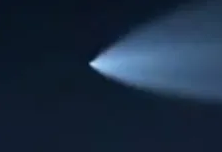
It was late on Monday 27th September when the first reports started coming in of a funnel-shaped object being seen in the sky. The first I was aware of it was when this post made in our Facebook group at around 22:30.

Lots more reports then started flooding from around the UK, from as far south as Somerset and Kent to as far north as Scotland. Facebook groups and Twitter particularly became alive with many posts and photos of the object being shared, including this one which was included as part of an official sighting report submitted to us.
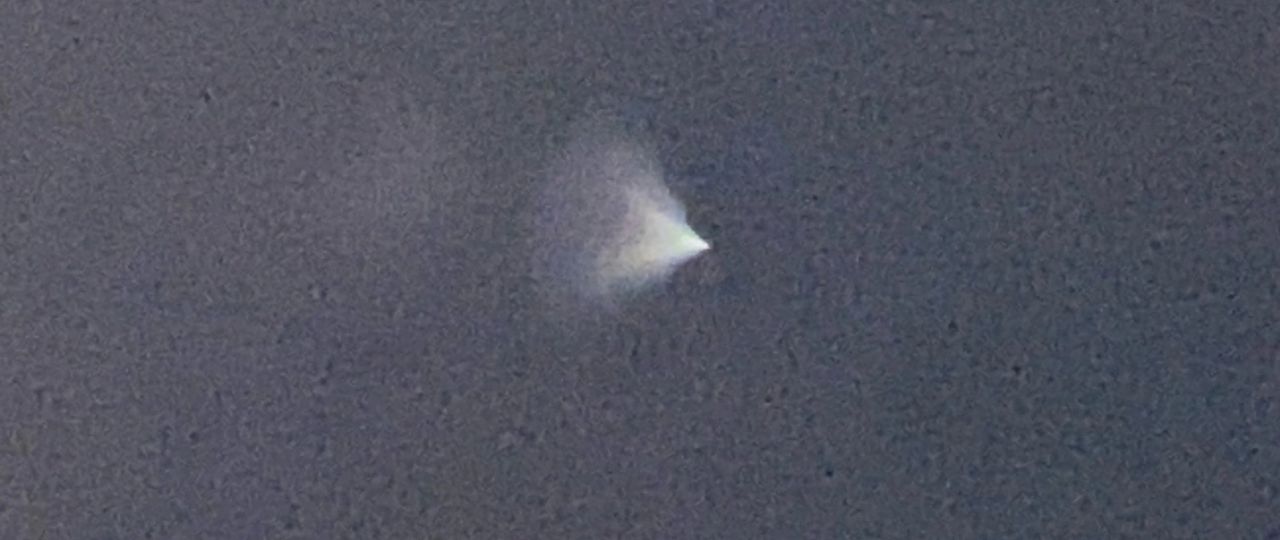
It didn’t take long for the media to pick up on the sightings, with Kent Online seemingly to be the first one to pick up the story about the unidentified object, an article which has since been revised to detail the real explanation of what was being seen.
Being familiar with a wide range of unusual looking things in our sky, and especially of different stages of rocket launches, it was clear straight away that this was some kind of rocket launch. Looking at the similarities between this image and one of a recent SpaceX launch below, the similarities are obvious, with the only question remaining being “Which rocket?”.
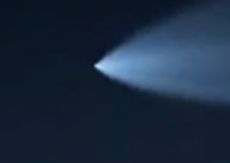
A little digging later, I discovered that it was actually NASA’s Landsat 9 satellite that had been launched using an Atlas V rocket that had taken off from the Vandenberg Space Force Base in California a few hours earlier at 19:12, a launch that was actually delayed from the 16th September due to a high demand of liquid oxygen needed to help treat Covid-19 patients.
The Landsat 9 will continue the Landsat program which monitors global climate change, forest cover, crops and water resources. So, we know what it was, but why does it look like brilliant in these images causing so many UFO reports?
The Atlas V uses Centaur rockets to boost their payload (satellite) into orbit. The first burn sends the Centaur rockets and Landsat 9 into orbit. Just before the second burn, Landsat 9 separates from the Centaur upper stage to begin its mission. The second and third burns allow the manoeuvre of the rocket into a lower orbit to deploy it’s second payload (four CubeSats, one which will study the boundaries of the Earth’s magnetic field, one which will study planets outside of solar system, and two military CubeSats to test advanced communication technology).
At 22:10, minutes before the first reports started coming in, the Centaur upper stage’s RL10 engine fired a fourth time for a deorbit burn that steers the spent rocket back into the Earth’s atmosphere for it’s re-entry over the Pacific Ocean. This fourth burn was the only one that would have been visible from the UK, and this is what was seen by so many people across the country.
Interestingly, this the first time that the capability to utilise all four burning stages has been taken advantage of, with all previous Landsat missions using no more than three Centaur burns.