
By Natalie Myers
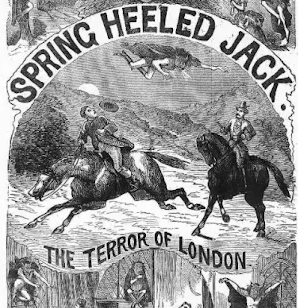
The cryptid known as ‘Spring-Heeled Jack’ started in 1837 in London culminating in his last known sighting in Liverpool in 1904.
The story starts when a girl named Mary Stevens was walking through London towards a house where she worked as a servant. The route took her via Clapham Common which was where a strange cloaked figure jumped out. He gripped Mary very tightly, ripping her clothes and touching her exposed flesh with claw like hands. He also tried to kiss her during the attack. Screaming at the top of her voice, the attacker fled as several people gathered to see what was happening. No trace of the perpetrator could be found. Mary recalled his touch being like that of a corpse.
The very next day, close to the first attack, a similarly dressed figure jumped in front of a traveling horse and carriage. The crash led to the coachman being severely injured but the incident was witnessed by several passers-by. People saw the man flee by jumping over a 9ft wall whist laughing in a high pitch cackle. News of both attacks spread and appeared in local press. It was the press who coined the name of ‘Spring–heeled Jack’.
What followed was a string of attacks reported to the Lord Mayor of London and to the Police. Each case was similar in presentation, usually targeting a young female servant by a cloaked man, who jumped abnormally high, had claws, was very cold to the touch and was seen jumping across the rooftops of London as a means of escape.
Jane Alsop described in a statement to the Magistrates Court that her attacker “was wearing a kind of helmet and a tight fitting white costume like an oilskin and he vomited blue and white flames!” Jane had answered the door of her father’s house to a man who claimed to be a Policeman. The man claimed he had caught Spring-Heeled Jack. Jane was told to bring a light and so followed the man outside with a candle. Once outside she noticed the man was wearing an unusual black cloak, but handed him the candle anyway.
He immediately relieved his “hideous and grotesque” appearance to Jane. He began tearing her clothes with claw like talons which she believed were made of a metallic substance. She managed to escape momentarily and made it back to the steps of the house, where Jack jumped on her and slashed her arms and legs with his claws. And just like that he was gone, leaving Jane bleeding on the doorstep to eventually be found by her sister.
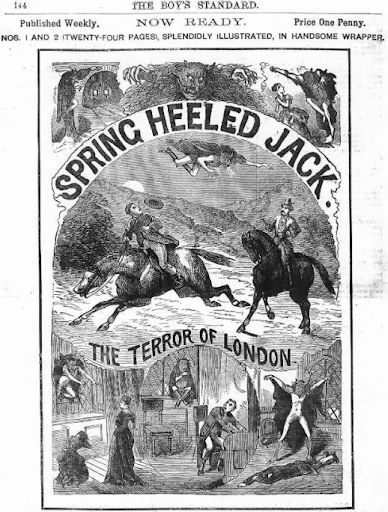
One of Jack’s later, and most talked about, attacks was in 1872 when Jack jumped out on a group of soldiers, slapping one across the face. One of the men shot Jack but the bullet appeared to pass through him. The soldiers reported this antagonised Jack who then roared at them with blue flames coming from his mouth. He was seen by the same group a few days later and was again shot upon; however was just seen jumping up and away from the area making haste as he went.
As the years went on, sightings began to change geographically. Spring-heeled Jack reports were recorded in Wales and Scotland. The last reported sightings were in Liverpool as his appearances migrated towards the northern end of the country. He was spotted in the Everton district on top of St Francis Xavier Church in 1888, then again in 1904 in William Henry Street.

Jack’s unnatural ability to jump was his truly unique characteristic, witnesses recalling him able to jump over 20 meters in height. There are others that stated he simply disappeared in the air once he had made the high jump upward.
So who, or what, was Spring-Heeled Jack?
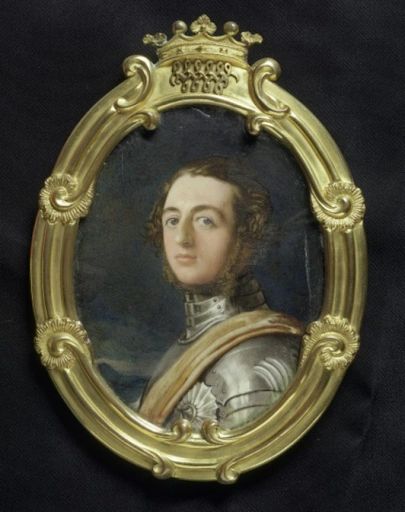
Henry De La Poer was known as being “wild” and “mad” by Victorian Society and was often linked to being Spring-Heeled Jack. He, however, had no history of being violent. The reported cases also continued after Henrys death in 1859 during a horse riding accident. Some researchers say that he had some traumatic experiences with women during his life which led him to create a character in which he could lead out his fantasies. He was a prominent figure in the news of that time due to his often drunken behaviours and was in London at the times of the first attacks. He also had a fondness for pranks, scaring people and jumping out on them in very juvenile way. The case against Henry was never proven.
A man named Thomas Millbank was arrested for being the perpetrator of the attacks shortly after the attack on Jane Alsop. He was heard bragging about the attacks at a local pub. Thomas appeared at Lambeth Street Court but was found not guilty.
Another suspect was Charles Grenville. Charles was an odd looking chap with a ‘gangly’ appearance. He was arrested after frightening a number of women in London, however due to his low level of intellect; he was never considered to be a viable suspect and was never charged.
There are also many who believe the tales to be nothing more than that. A story that was gossiped about altered and exaggerated over the years. However the tales of Jack were not just in Britain. Around 1939-1945 in Czechoslovakia, tales emerged of Perak – the Spring Man of Prague who demonstrated eerily similar characteristics.
There have been those who have speculated Jack is an extra-terrestrial being, given his odd appearance, super human agility and blood red eyes. His jumping ability attributed to life on a high gravity world. Others think he is a demon summoned by occult practitioners in order to bring chaos and fear. The Morning Chronicle of 1838 described how it was in fact not a man who was terrorising the people of Peckham but “the pranks of the ghost, imp or devil”. The press in Liverpool concluded Jack was “a man with religious mania”.
Jacks springing action has for now come to an end, however we will probably never really know who he was, where he came from and why he jumped his way around the country leaving behind a string of bewildered witnesses.